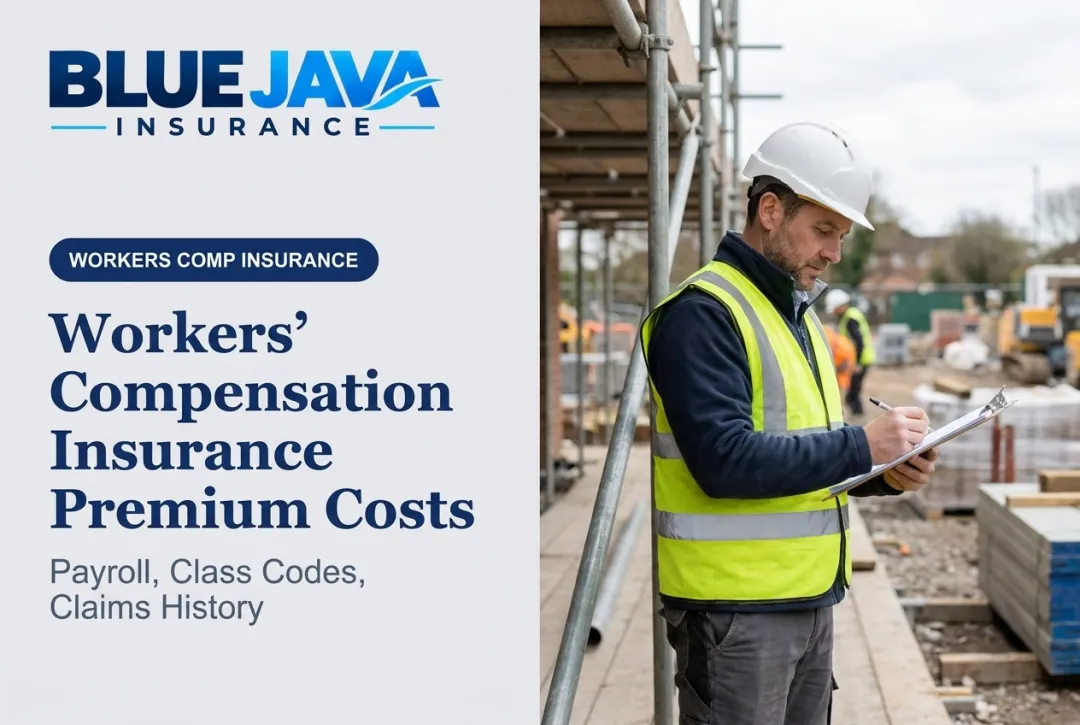

Construction also carries real injury exposure. The BLS counted 1,034 construction deaths in 2024, the most of any private industry. Insurers price that risk in.
There is no single national price. Premiums depend on your state, trade, payroll, claims history, and how your workforce is structured. This guide covers current benchmarks, how premiums are calculated, the main cost drivers, overlooked charges, and how to build a realistic budget.
Key Takeaways
- One marketplace benchmark puts small construction policies at about $175/month ($2,101/year), but it is not a quote.
- Payroll, class codes, state rules, claims history, and experience modification drive cost.
- Office staff and stable, low-claim firms pay less than roofers or electricians.
- The cheapest quote fails if it misclassifies workers or skips states.
How Much Does Workers' Comp Insurance Cost for Construction?
Construction employers often struggle to pin down a single premium figure because no fixed national rate exists. Your cost depends on state, annual payroll, employee roles, and type of work.
The ranges, role profiles, and payroll examples below show why quotes vary and how to frame a realistic estimate.
Typical cost range
Insureon reports that construction businesses buying through its marketplace paid an average of $175/month ($2,101/year). Insureon does not disclose sample size, states, payroll, or limits. Treat the figure as a small-business reference point, not a national average.
Other figures show why ranges are wide:
- All industries, nationally: employer costs run about $0.98 per $100 of covered wages (NASI, 2023 data).
- California, all classes: the advisory pure premium averages $1.52 per $100 of payroll for policies effective September 1, 2025, and $1.65 from September 1, 2026.
- North Carolina, proposed 2025 filing: pure premiums of $3.95 for class 5190 and $5.61 for class 5183 per $100 of payroll.
Pure premiums are not final carrier prices. Insurers add expenses and apply their own adjustments.
Cost profiles by role
- Office employees: the lowest rates, provided they have no field duties.
- General field crews: mid-range rates that climb with exposure.
- Roofing and heavy equipment work: typically the highest rates, reflecting falls, machinery, and severity of injury.
Two educational examples
These illustrations use the formula: payroll ÷ 100 × class rate.
- Electrical crew, $400,000 payroll, assumed rate of $4.00 per $100: 4,000 × $4.00 = $16,000.
- Office staff, $80,000 payroll, assumed rate of $0.30 per $100: 800 × $0.30 = $240.

Apply an experience modification if one exists, then add fees and assessments.
What the policy covers
Workers' comp pays medical care, wage replacement, disability, and death benefits for work-related injury or illness, plus employers' liability. It does not replace general liability, commercial auto, tools and equipment coverage, or contractor bonds.
Key Factors That Affect Construction Workers' Comp Cost
Insurers weigh the size of your workforce and both the likelihood and severity of injuries.
State and jurisdiction
States differ on who must carry coverage, owner exemptions, rating rules, and assessments. California generally requires coverage with even one employee. North Carolina generally requires it at three.
North Dakota, Ohio, and Washington run state funds, with limited private options. Verify rules in every state where you have employees or perform work.
Payroll and workforce size
Premium equals estimated gross payroll ÷ 100 × the class rate. Construction payroll moves with seasons, overtime, new hires, and temporary labor. Update your estimate before the audit, not after.
Class codes and actual duties
Rates follow the work performed. A roofer, electrician, plumber, laborer, equipment operator, and clerical employee can each land in a different class.
Ohio BWC notes clerical exceptions only apply when those employees have no other duties in the operation. Construction classifications also carry special rules.
Claims history and experience modification
The experience mod compares your payroll and losses with similar employers, generally over about three years. Better results earn a credit; worse results a debit.
NCCI explains that eligibility is state-specific. New businesses may be rated differently, so ask your agent how your state treats them.
Job-site hazards
Work at height, excavation, heavy machinery, electrical work, demolition, traffic exposure, and confined spaces all raise risk.
Documented safety training, protective equipment, incident reporting, and return-to-work programs support better underwriting. Some states offer credits too. Florida's drug-free workplace program offers up to 5%.

Subcontractors, owners, and multi-state work
- Uninsured subcontractors can become your premium and compliance problem. North Carolina law can make a contractor liable if the required certificate isn't obtained.
- Collect certificates of insurance and keep written subcontractor agreements.
- Owner inclusion or exclusion varies by state and entity type.
- Standard policies cover other states only if they're listed. Disclose every state you work in.
Workers' Comp Cost Breakdown and Lower- vs Higher-Cost Policies
Your budget may include more than the base premium, and estimates can change after an audit.
Base premium calculation
Class rate × experience mod (if applicable) × payroll ÷ 100. Filed rates, credits, debits, minimum premiums, and carrier adjustments vary by state and insurer.
Additional charges and audit costs
- Assessments: California's 2025–26 methodology includes separate factors such as 0.014958 for its Administration Revolving Fund.
- Fees: policy fees, minimum premiums, and installment charges may appear.
- Audits: Per NYSIF, actual payroll and work performed can raise or lower the premium. Underreporting or an unreported new class creates a balance due; overestimating ties up cash until reconciliation.
Payment structure and cash flow
- Annual payment: largest upfront cost, often the simplest to manage.
- Installments: spreads cost but may add charges.
- Pay-as-you-go: NYSIF describes it as $0 down, with payments based on actual payroll each pay period, so changing payroll is tracked and audit surprises are softer.
Payment flexibility changes how you pay, not your coverage obligations or the need for accurate reporting.
Lower- vs higher-cost profiles
| Factor | Typically lower cost | Typically higher cost |
|---|---|---|
| Payroll | Small, stable | Large, seasonal |
| Duties | Office, light trades | Roofing, heavy equipment |
| Claims | Clean record | Frequent or severe claims |
| Safety | Documented program | Little documentation |
| Projects | Low-height, low-hazard | Multi-site, high-hazard |
A lower premium often reflects lower payroll or risk, not weaker protection. A higher one can be appropriate for a larger or more hazardous operation.
Long-term value
Correct class codes, complete payroll reporting, and the right state coverage beat the lowest first quote. Don't drop needed employees or misdescribe duties to cut cost. Penalties are steep: California lists fines of at least $10,000 and possible stop orders, and New York can issue stop-work orders.
How to Estimate the Right Construction Workers' Comp Budget
Build the budget from your actual operations and expected payroll, not a per-employee average.
Gather the information insurers use
- Legal business details and states of operation
- Projected gross payroll by employee
- Job duties for each role
- Subcontractor use and certificates
- Owner or officer inclusion status
- Five years of claims history
- Expected hiring, growth, or new service lines
Compare quotes and validate assumptions
Get quotes from qualified carriers or through an independent agency. Confirm every quote uses the same payroll, class codes, states, limits, deductibles, fees, and payment terms. Otherwise you're comparing different products.

Blue Java Insurance is an independent agency that isn't tied to one carrier. It helps business owners explore workers' comp and related commercial coverage through a human-supported process built around how the construction business operates. You can upload current rating pages or a renewal offer when you request a quote.
What most people miss
- Initial premium only: audits, payroll growth, assessments, minimum premiums, and installment charges all change the final cost.
- Misclassification and subcontractors: assuming uninsured subs are exempt, or skipping multi-state work, creates compliance and premium problems.
- The bigger picture: workers' comp sits beside general liability, commercial auto, tools and equipment coverage, and any contract-required limits
One California sample state contract, for instance, calls for $1 million in employers' liability, though that isn't universal.
Conclusion
Construction workers' comp costs depend on several factors:
- State requirements and rate structures
- Payroll size and trade classification
- Job-site hazards and claims history
- Experience modification rate
- Workforce structure (employees vs. subcontractors)
A realistic budget starts with accurate payroll and class codes, current state guidance, like-for-like quote comparisons, and coverage that matches how you actually work.
Frequently Asked Questions
How much should workers' comp insurance cost in California?
It depends on trade class, payroll, claims history, experience mod, and California's rating rules. The all-class advisory pure premium averages $1.65 per $100 of payroll from September 1, 2026, but construction classes vary and this isn't a quote.
How long can you be on workman's comp in North Carolina?
Duration depends on benefit type, medical findings, return-to-work status, and state rules. The statute has a general 500-week limit for specified total-disability compensation, with exceptions. Check current Industrial Commission guidance for individual claims.
How long can you stay on workman's comp in California?
It varies by benefit type, injury, medical evaluation, and state limits. Temporary disability generally runs up to 104 weeks within five years for injuries on or after January 1, 2008. That's separate from what employers pay for coverage.